

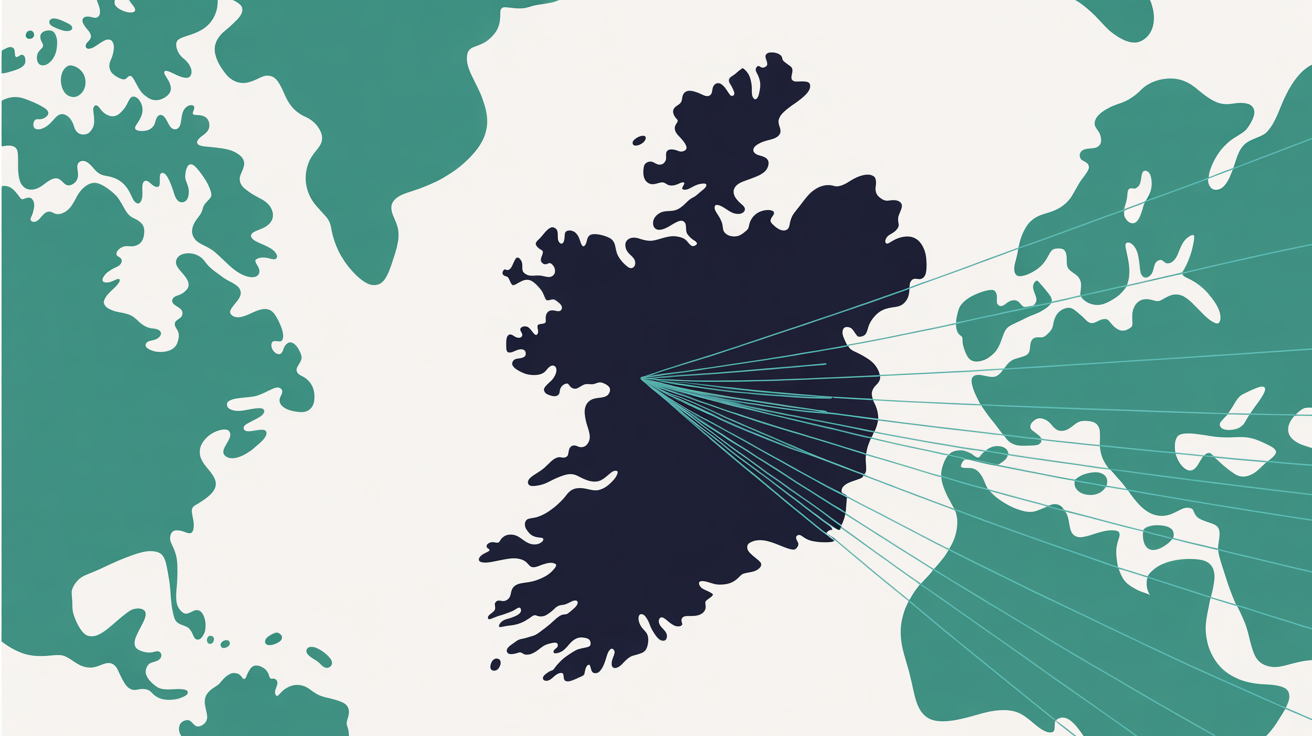
Most "Irish hosting" is not Irish in any meaningful sense. The data centre might be in Dublin. The company that owns the data centre often is not. And under the rules that actually decide who can access your customers' data, ownership matters more than postcode.
I am writing this on a quiet Tuesday morning. Part of last week's operational review involved a pattern we see more often than we should: a customer who had been telling their own clients, in writing, that all their data stayed in Ireland, while the actual hosting sat in Frankfurt and was operated by a US-registered parent company. The provider's homepage still said "Hosted in Ireland". None of that was outright fraud. It was just marketing language that had wandered a long way from operational reality.
This is the default state of the Irish hosting market.
The phrase "hosted in Ireland" is doing two jobs in a single sales line. One is geographic: where do the bits physically sit? The other is jurisdictional: whose courts can compel access to those bits? Most Irish business owners assume the two are the same question. They are not. And in 2026, with the EU Data Act applying and a Schrems III case quietly building in the Irish High Court, the jurisdictional answer is the one that matters.
What "Hosted in Ireland" Means on a Hosting Sales Page
There are three common variants of the claim, and they map to very different realities.
The first is the genuinely Irish provider, registered in Ireland, operating from a data centre in Ireland that they either own or have a direct contract with. This is the rarest case. There are perhaps a handful of providers operating at this level on the SME side of the market.
The second is the international provider with an Irish point of presence. They will have an Irish company entity, an Irish phone number, and a Dublin sales address. The actual hosting may run on a virtualised slice of an AWS, Azure, or Google Cloud region. AWS alone runs multiple facilities in the Dublin area, and Microsoft has expanded its Grange Castle estate to support Azure. So when a small reseller says "your site is in Ireland", what they often mean is "your site is on a virtual machine inside one of those US-owned facilities".
The third variant is the bait-and-switch. The marketing page says Ireland. The DNS records and the WHOIS data point to a server in Frankfurt, London, or further afield. It is not always intentional. Some providers quietly move loads to wherever they have spare capacity, and the marketing copy never gets updated. The result for the customer is the same.
The CLOUD Act: Why Geography Is Not Sovereignty
If your data sits in Dublin but your hosting provider is a US-headquartered company, US authorities can compel that provider to hand the data over.
That is the practical effect of the US CLOUD Act, in force since 2018. It gives American agencies the power to subpoena data held by US-headquartered companies, regardless of which country the data physically lives in. A Frankfurt server, a Dublin server, a London server: location does not matter. Jurisdiction follows ownership. The European Data Protection Board has confirmed that EU-based providers cannot legally rely on a CLOUD Act request as a basis for transferring data to the US, which leaves any provider caught between the two regimes in an uncomfortable spot.
The European Commission has tried to fix the resulting standoff with the EU-US Data Privacy Framework, adopted in 2023. That framework is already facing legal challenges in the Irish courts, with Max Schrems given approval in February 2024 to participate in cases that may eventually become Schrems III. The pattern of the last decade has been one transfer mechanism after another being struck down, replaced, and challenged again. Layered on top, the EU Data Act, in force since January 2024 and applying since September 2025, requires cloud providers operating in the EU to implement technical and legal measures to prevent unlawful non-EU government access to data stored in the EU.
Take a Limerick accountancy firm storing client tax data on a "hosted in Ireland" site that is in fact a US-owned virtual machine in Dublin. The marketing line is intact. The legal position is far more uncertain than the firm thinks, and could weaken further if a Schrems III ruling, a Data Protection Commission audit, or a CLOUD Act request reaches the provider. That is not a hypothetical. It is the dependency chain most Irish SMEs are sitting inside without knowing it. The same pattern shows up across most Irish business websites that fail data protection audits: the data sits in the wrong place, owned by the wrong company, under the wrong jurisdiction.
Three Ways to Verify Where Your Site Actually Lives
You do not need a compliance team to verify any of this. You need ten minutes and three free tools.
Run a hosting check. Drop your domain into a public hosting checker such as Hosting Checker, IPVoid, or Site24x7's Find Website Location tool. Each will return the IP address your domain points to, the autonomous system or data centre that owns the IP block, and a city-level geolocation. Note the data centre. If it returns AWS, Microsoft, Google, OVH, Hetzner, or any other globally branded operator, your hosting is on a non-Irish-owned cloud, regardless of what the sales page said. City-level geolocation accuracy is in the 50 to 75 percent range, so treat the city result as a strong hint rather than a definitive answer; the data centre owner is the more reliable signal.
Verify the company, not just the domain. The Companies Registration Office search at cro.ie tells you whether your provider is an Irish-registered company and where its registered office sits. An Irish trading name attached to a UK or US parent is fine for many things; for data sovereignty it is not the same as an Irish-owned operator answering only to Irish and EU law.
Ask the provider directly, in writing. This is the one most business owners skip. A short email asking three questions. Which data centre houses the production environment. Which company legally owns that data centre. Which jurisdiction the provider would respond to in the case of a foreign government data request. A provider who is genuinely Irish and operating Irish infrastructure will answer in two paragraphs. A provider relying on the marketing version will hedge, redirect, or take a week to reply. Both responses tell you what you need to know.
If those three checks come back clean, you have an Irish-hosted site in the meaningful sense. If they do not, your hosting is geographically Irish at best and not Irish at all in jurisdictional terms.
When "Irish Hosting" Does Not Have to Mean Sovereign
Now the honest concession.
Not every Irish business actually needs sovereign Irish hosting. If you run a brochure site for a service that takes no online bookings, holds no customer database, processes no payments, and runs no contact form, the question of who can subpoena your data barely arises. There is nothing on the server beyond pages a stranger could read by visiting your URL. A standard EU-region cloud host, US-owned or not, suits that workload perfectly well, and you would be paying for sovereignty you do not use.
The reason to insist on properly Irish hosting is the data behind the public site. Customer enquiries, mailing-list opt-ins, eCommerce orders, member portals, GDPR-relevant logs, anything that names or identifies a person. Once that exists on your platform, where it lives and who can be compelled to produce it stops being a marketing detail. It becomes part of the legal commitment you make to every customer who fills in a form.
What Web60 Does Differently
Web60 is the consumer-facing platform built on top of SmartHost's hosting infrastructure. Both are Irish-registered companies, and the hosting estate is operated as an Irish sovereign cloud. The production environment your WordPress site runs on physically sits in Ireland, owned and run by the same company that takes your support call.
In practice that means three things. The data centre answer is one country, not three. The legal jurisdiction is Ireland, not Delaware. And the support team you ring at half ten in the morning is the same team that signs off on the operational changes overnight. Underneath, the platform runs the WordOps stack: Nginx in front of PHP-FPM, Redis object caching, FastCGI page caching, automatic nightly backups with one-click restore, free SSL via Let's Encrypt, and server-level hardening with fail2ban. None of that is unusual; most managed WordPress hosts will list the same components. What is unusual is having all of it run inside a jurisdiction your customers actually expect, on Web60's Irish-hosted infrastructure for €60/year all in, rather than as a premium add-on.
One sync reality check, because it matters. Data sovereignty is not the same as network isolation. Your DNS still resolves through global resolvers. Customer browsers still talk to your server over the public internet. If you put a third-party CDN, analytics script, or chat widget on your pages, those services run wherever their owners run them. Sovereignty applies to where your site, your database, your backups, and your administrative access live; it does not extend to every third-party tag a marketer might bolt on later. Be deliberate about what you add to a sovereign site, and the legal commitment you made to your customers stays intact. The wider WordPress security and backup approach behind a properly run Irish site starts from exactly that posture.
I have made the wrong call here once myself. Years ago I signed off on a setup where the application sat in an Irish data centre, but the email and cron processing lived on a US-owned platform we had inherited from the previous host. Technically the customer database was Irish; functionally, parts of it were copied across the Atlantic every hour. We caught it during a routine audit and rebuilt the dependency in-region. The lesson was not the technical one. It was that "hosted in Ireland" needs to apply to the whole stack, not just the front door.
What This Means for Your Next Hosting Decision
You do not need to switch to Web60 to get this right. You do need to know what you have.
Three questions for your current provider, in writing, this week. Where does the production environment physically run? Which company legally owns the data centre? Which jurisdiction would the provider respond to in the case of a non-EU data request? If the answers are all Ireland, you are sorted. If any of them are not, you have a decision to make about whether the site you are running today still matches the legal commitment you made to your customers when they signed up.
The marketing line was never the answer. It was the question.
Sources
Ian oversees Web60's hosting infrastructure and operations. Responsible for the uptime, security, and performance of every site on the platform, he writes about the operational reality of keeping Irish business websites fast, secure, and online around the clock.
More by Ian O'Reilly →Ready to get your business online?
Describe your business. AI builds your website in 60 seconds.
Build My Website Free →More from the blog
Spam User Registrations on Your Website: Who They Are and How to Stop Them
Strangers signing up to your WordPress site? Spam user registrations can send email in your name and open security holes. Find the settings and close them.
Uploaded Files on Your Website Are Public. Even the Ones You Never Linked.
Uploaded files on your website are public, even on a private page. How PDFs end up in Google, how to find and remove yours, and when it counts as a breach.