

Irish SME
AI-Generated Photos on Your Business Website Are a Promise You Have to Keep
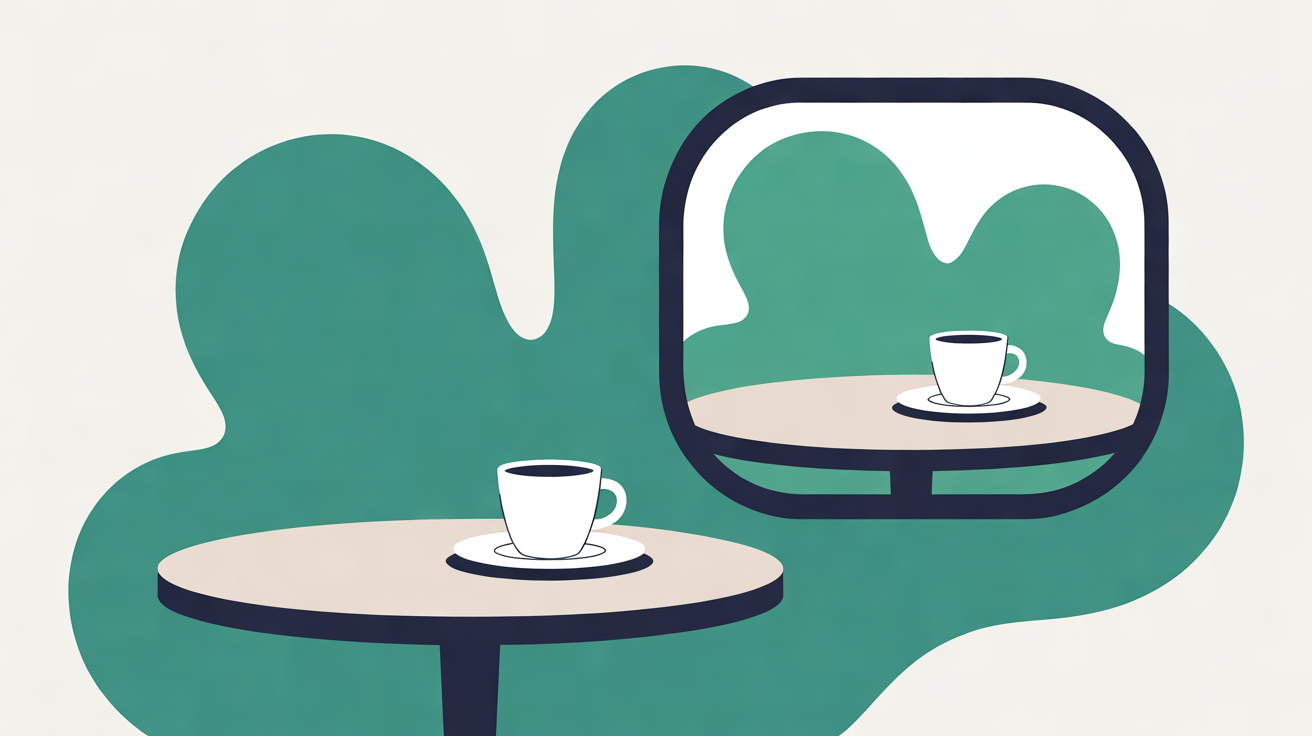
"Is this even the same café?" A customer asked it at the counter, holding her phone up beside a plate of eggs Benedict. On the screen was the café's new website: a glowing plate with flawless hollandaise, steam rising off thick sourdough, and behind it a sunlit room with a long oak table and plants trailing from the ceiling. On the counter sat the actual breakfast. Perfectly decent. Nothing like the picture.
I should be straight with you. That café is a composite, a small Louth café pieced together from conversations I have had with owners over the past year rather than one business's story. Every part of it happens, though. During an autumn website refresh, with a new brunch menu to launch and no time for a photographer, the owner asked an AI image tool for a picture of each dish and one of the room. Twenty minutes, start to finish. The results looked better than anything a phone could manage, and that was precisely the problem.
The new site went up midweek. By the first Saturday, more than one customer had made the same comparison at the counter. On the Monday, a Google review appeared under the café's name: food fine, staff lovely, photos online are fake. A couple of others agreed with it. Nobody set out to con anyone. The owner did what every AI tool now quietly invites you to do, and found out the hard way that a photo on a business website is not decoration. It is a promise.
Why the Picture Felt Harmless
You can see how it happens. AI image tools are built into phones, design apps and plenty of website builders now. You type "brunch plate, natural light, rustic café" and something beautiful arrives in seconds. Compared with booking a photographer, clearing the room and waiting for the edit, it feels like the obvious shortcut.
The trouble is how customers use your photos. They are not admiring them. Customers are checking. Is the room big enough for a group? Will the portion justify the price? Does the place look clean, busy, quiet, child-friendly? A photo answers those questions faster than any paragraph, which is why people trust it more than the paragraph.
Shoppers are already wary. In a June 2026 survey of more than 2,000 US online shoppers, Baymard Institute found that roughly six in ten said knowing a product image was AI-generated would reduce their confidence in buying, and around one in six said they would not feel confident enough to buy at all [1]. That is American data about online shopping, so I would not map it one-to-one onto an Irish café. But the direction matches what owners tell me: customers forgive an ordinary photo far more readily than one that turns out to be invented.

So the café's twenty-minute shortcut bought it a week of awkward conversations, a review that will sit near the top of its listing for months, and a quiet question in the head of every new customer who reads it. Not a great trade.
What the Café's Photos Actually Promised
When I talk to owners about this, the first reaction is usually: it is only a picture, everyone knows photos are styled. Fair enough, up to a point. Food photos have always been lit and plated with care, and nobody expects your Tuesday lunch to look like a magazine cover. There is a difference, though, between showing your real dish at its best and showing a dish that never came out of your kitchen. And a room that does not exist is a different thing again.
Consumer law in Ireland cares about that difference. The Competition and Consumer Protection Commission's October 2025 letter to tradespeople, which restates the general rules under the Consumer Protection Act 2007, says traders should not give false, misleading or deceptive information that could cause the average consumer to make a decision they would not otherwise make, including about the main characteristics of what is being sold [2]. That same letter notes that under the Consumer Rights Act 2022 a service must comply with anything the trader said or wrote that the customer relied on when deciding to buy [2].
I am not a solicitor, and I would not tell you a single AI picture of a plate puts you in legal jeopardy. Context matters enormously. Put simply, the law already treats what you show customers as part of what you are offering them. An image of a room you do not have, used to sell a function booking, is the kind of thing that turns an annoyed customer into a formal complaint. If you are unsure where your own images sit, a short conversation with your solicitor is cheaper than finding out from a complaint.
Google Already Asks for the Real Thing
Even if the law never comes near you, the platforms customers use to find you have their own rules, and they are not vague.
Your Google Business Profile
Google's own guidance on business photos is short and blunt. It asks for photos that are in focus, well lit and with "no significant alterations or excessive use of filters or AI", and it sums up the requirement in one line: the image should represent reality [3]. The same page tells you to add exterior photos so customers can recognise your building, interior photos that show what it feels like to stand inside, and photos of the products you actually sell [3].
What does that mean for the café? The AI room and the AI plates that went onto the website were also uploaded to its Google listing, because that is what you do when you finally have nice pictures. Those are exactly the images Google's guidance says it does not want. And the listing is where most local customers meet you first, often before they ever see your website.
Google Shopping and Merchant Center
If you sell products online and feed them into Google Shopping, the rules are firmer still. Google's Merchant Center policy says all images created using generative AI must carry metadata indicating they were AI-generated, and that you must not strip that embedded information out [4]. AI-written product titles and descriptions have to go into separate attributes flagged as AI-generated too [4].
In plain terms: if an AI tool made your product photo, Google expects the file itself to say so. Many owners run every image through a compression or resizing tool before uploading, and some of those tools strip metadata as a side effect. That is how a perfectly honest shop ends up out of line with a policy it never knew existed.
The AI Act Question Nobody at the Café Had Asked
This is the part most owners have not heard about. Since 2 August 2026, Article 50 of the EU AI Act has applied, bringing transparency duties for people who publish certain AI-generated content [5].
For a small business, the relevant one is the "deep fake". The Act's definition is wider than most people assume. It covers AI-generated or manipulated images that resemble existing persons, objects, places, entities or events and would falsely appear to a person to be authentic or truthful. The European Commission's guidance says anyone deploying a deep fake must disclose it clearly, at the latest on first exposure, using a label people can actually see rather than hidden file data [5]. Small businesses are not exempt, although the Commission notes proportionality can be considered for smaller firms when it comes to fines [5].
Does a Picture of Your Own Premises Count?
Possibly. An AI picture of your own café's interior, presented as the real room, depicts a place that exists, and it would falsely appear to be a genuine photo of it. The Commission also says content generated before 2 August 2026 does not need to be labelled retroactively, though it encourages labelling where possible [5].
We covered the wider picture in our guide to what the EU AI Act actually asks of a business website. The honest summary is that this area is new, the guidance is still bedding in, and nobody can give you a definitive answer for your specific images without seeing them. The safest position is also the simplest one: do not present AI images as photographs of your real premises, people or products.
Where AI Imagery Is Perfectly Fine
I do not want you leaving this article thinking AI images are poison. They are not. The problem is pretending, not the tool.
Plenty of uses are entirely reasonable:
- Obvious illustrations. A flat, clearly stylised header graphic, a pattern behind your opening hours, an icon set. Nobody mistakes those for photographs of your premises.
- Mood and seasonal artwork. A wintry abstract banner for your Christmas opening hours does not promise anything about your room or your food.
- Standard editing of your own photos. Straightening a wonky shot, fixing the white balance, removing a stray bin bag from the corner of an otherwise genuine picture. That is tidying the truth, not replacing it. Just stop well short of making the room bigger or the portions more generous.
- Concepts for things that do not exist yet. If you sell made-to-order work, such as bespoke cakes, garden designs or kitchen layouts, an AI mock-up of a possible design can genuinely help a customer imagine the result. Label it clearly as a concept, and never present it as past work.
That last one is the honest concession. For businesses that sell a design before it is built, AI imagery can be a real selling tool, provided the label is clear. For a café, a salon, a guesthouse or a shop, where customers come to see the real thing, it is a liability dressed up as a shortcut.
One limitation is worth knowing before you start swapping pictures. Replacing an AI image on your website does not remove it from everywhere it has already travelled. Copies shared on social media, a screenshot in someone's review, an old version stored by Google until its next visit: those linger. And the review that called your photos fake stays up. What you can do is reply to it calmly, say the photos have been replaced with real ones, and let the next visitors see the difference for themselves.
Swapping AI Pictures for Real Ones in Five Steps
If you have AI images on your site already, this is a calm job, not an emergency. Give it a quiet afternoon.
- Audit. Go through every page and your Google listing and note each image that shows your premises, your people, your food or your products but was not actually photographed there. Those are the ones that matter. Decorative graphics can stay.
- Capture. Take replacements on your phone in good daylight: the outside from the direction customers arrive, the room from where a customer would stand, your three or four best sellers as they really leave the kitchen or the workshop.
- Stage. Upload the new photos to a staging environment first, if your hosting gives you one, so you can view the full page on a phone before customers do. A gallery that looks fine on a laptop can crop someone's head off on a mobile.
- Deploy and verify. Push the changes to production, then open the live pages on your phone and on someone else's. Verify the old AI files are gone from the media library, not just from the page, and replace the matching photos on your Google Business Profile.
- Label what stays. Anything AI-generated that you keep, such as a concept design, gets a short visible caption saying so. If you feed Google Shopping, verify your image tools are not stripping the AI metadata from those files.
The point of the staging step is the same as in any other change: you would rather spot the broken layout yourself on a Wednesday than hear about it from a customer on a Saturday. And if something does go wrong after you deploy, a recent backup means the rollback takes minutes, not an afternoon of rebuilding pages from memory.
Let AI Build the Site. Let Your Camera Prove It Is Real.
None of this is an argument against using AI on your website. Quite the opposite. WordPress runs a little under four in ten of all websites according to W3Techs [6], and AI has finally removed the barrier that kept business owners from building on it themselves. Describing your business and getting a professional structure, layout and first draft of copy in under a minute is a genuinely better deal than paying an agency thousands and waiting weeks for the same thing. That is the job Web60's AI builder does, turning your own description into a working WordPress site for €60 a year, with hosting, SSL, nightly backups and staging included.
But notice where the AI earns its keep. It is fast at structure, layout and words, which are the parts you can check and edit yourself in an afternoon. No AI can stand in your café at nine on a Saturday morning, and it should not pretend to. The broader shift towards AI-powered WordPress for business owners works best as a partnership: the machine does the heavy lifting on the build, and you supply the truth.
The café in our composite got there in the end. Real photos, taken on a phone on a bright morning, a polite reply under the review, and a website that now looks like the place you walk into. The pictures are a little less glossy than the AI versions, and customers stopped holding their phones up at the counter. Your own photos do not need to be perfect. They need to be yours. Take the phone, walk outside, and start with the view your customers see first.
Frequently Asked Questions
Is it illegal to use AI-generated images on my business website in Ireland?
Not in itself. AI images are lawful to use in many contexts, such as illustrations, banners and clearly labelled concept designs. The risk comes when an AI image is presented as a real photo of your premises, food or products and gives customers a false impression that influences their decision to buy. Irish consumer law already prohibits false or misleading information about the main characteristics of what you sell, and the EU AI Act adds disclosure duties for realistic AI images of real places, objects or people. If you are unsure about a specific image, ask your solicitor.
Do I have to label AI-generated images on my website?
It depends on what the image shows. Since 2 August 2026, the EU AI Act requires anyone publishing a deep fake, meaning a realistic AI image of an existing person, object, place or event that would falsely appear genuine, to disclose that clearly to viewers. An abstract header graphic or an obvious illustration does not fall into that category. A photorealistic AI image of your own shop presented as the real thing may well do. A short visible caption describing the image as an AI-generated illustration is a simple, low-cost habit for anything realistic you keep.
Can I use AI to edit or improve my own photos?
Yes, within reason. Straightening a photo, correcting colour, improving lighting or removing a stray object from an otherwise genuine shot is ordinary editing. Google's own photo guidance asks for no significant alterations or excessive use of filters or AI, so the line is crossed when the edit changes what a customer would actually find, such as making a room look larger, a dish more generous or a view that is not there.
Will Google reject AI-generated photos on my Business Profile?
Google's guidance for Business Profile photos asks for images with no significant alterations or excessive use of filters or AI, and says the image should represent reality. Even where an upload is accepted, AI images of your premises undermine the main job of your listing, which is to let customers recognise your business and know what to expect. Use real exterior, interior, product and team photos taken on location.
Can I use AI-generated product images in Google Shopping?
Google Merchant Center allows them, but all images created with generative AI must carry metadata indicating they were AI-generated, and you must not remove that embedded information. AI-written product titles and descriptions must be submitted in separate attributes that flag them as AI-generated. Check that any compression or resizing tool you use is not stripping the metadata from your image files.
What should I use if I have no good photos of my business yet?
Use your phone in good daylight rather than an AI substitute. Start with three exterior shots from the directions customers arrive, three interior shots from a customer's point of view and photos of your best-selling products as they really look. Until then, a clean layout with clear text and simple illustrations is far safer than a realistic image of a place or product that is not yours.
Sources

Eamon leads sales at Web60 and SmartHost, working directly with Irish business owners making the switch from cheap shared hosting to managed WordPress. With a background in enterprise technology sales — including Oracle and multiple Irish SaaS businesses — he understands the questions Irish SMEs ask before committing to a hosting platform. He writes about hosting comparisons, total cost of ownership, web design for Irish businesses, and how to evaluate what you’re actually buying.
More by Eamon Rheinisch →Ready to get your business online?
Describe your business. AI builds your website in 60 seconds.
Build My Website Free →More from the blog
Corporate Christmas Orders: How Your Website Wins Staff Gift Orders
Corporate Christmas orders come with tax rules, VAT invoices and payment terms attached. How a small business website answers them before the buyer asks.
Your Home Address on Your Business Website: What to Show and What to Keep Private
Running a business from home? What Irish consumer law expects your website to show, and how to keep your home address off maps, Google and the homepage.