
Industry News
AI Search Has Come for Irish Business. Most Websites Are Not in the Answer.
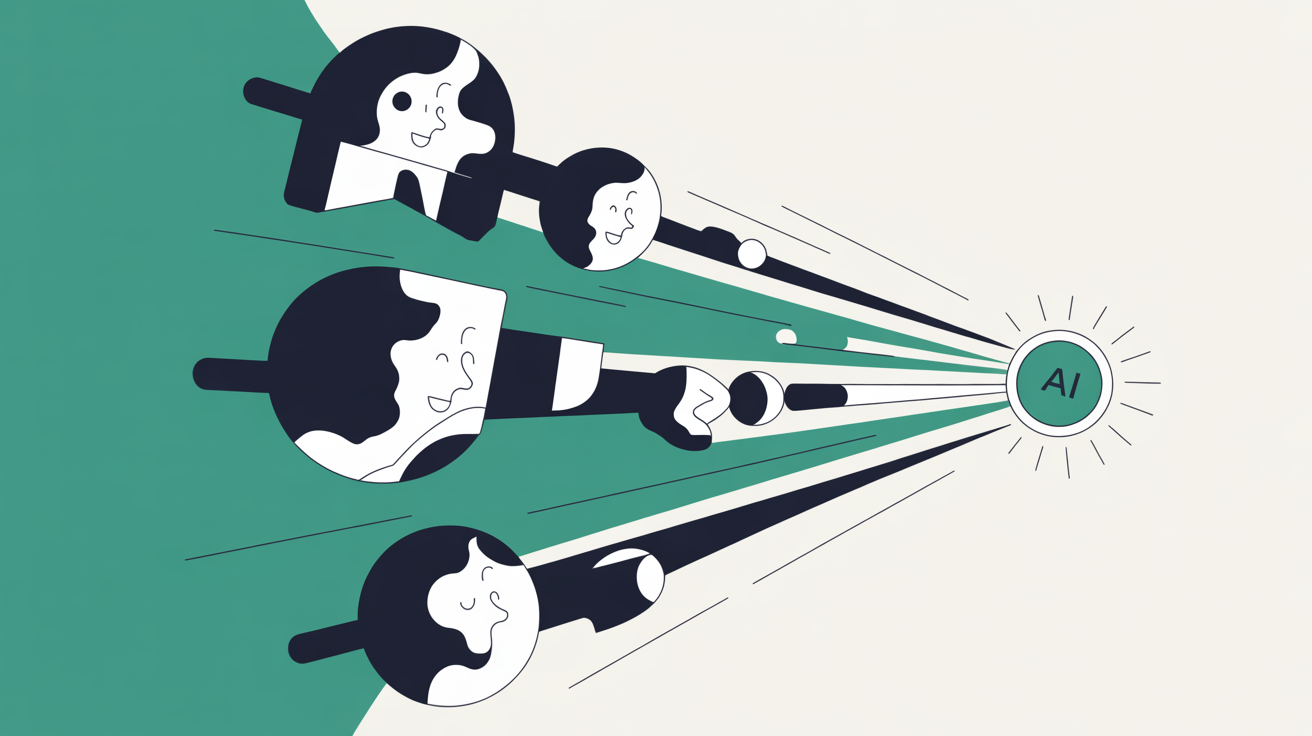
A custom joinery firm in Galway told me last quarter that the phone had stopped ringing the way it used to. Their Google rankings looked fine. The website had not changed. Reviews were still strong. But quotes were down and they could not figure out why.
We went back through the enquiries they had won that quarter and asked one question. How did you hear about us? A pattern emerged. The customers who came in through the door already knew who they were comparing them to. The customers who never got in touch, the ones the joinery would never see, had asked ChatGPT or Google's AI Overview where to get a custom kitchen made in Galway. A different cabinetmaker was in the answer.
That pattern is not unusual now. It is the shape of business discovery in 2026.
What Has Actually Changed
Look at the numbers. The proportion of consumers using AI assistants to find local business recommendations climbed from roughly 6% in 2025 to around 45% in 2026, according to BrightLocal's latest Local Consumer Review Survey [1]. That is close to a tenfold increase in a single year. AI is now the third most used tool for finding local businesses, behind only Google search and Facebook.
Google's own share of local discovery dropped from roughly 83% to around 71% over the same period [1]. Still dominant. No longer the only game in town.
The shift accelerated in March 2025 when Google rolled out AI Overviews to Ireland and several other EU regions [2]. By the end of the year, Semrush Sensor data showed AI Overviews appearing in roughly 15% of search results, with the number bouncing around as Google tuned the feature. Other research suggests AI-generated local packs surface around 30% fewer businesses than the traditional map pack, with much higher specificity on the businesses that do appear.
In plain English. There are fewer slots in the new front door, and the businesses that fill them are the ones AI can read, trust, and summarise.
What Happens When a Customer Asks AI a Local Question
Put yourself in your customer's shoes for a minute. They are at the kitchen table on a Sunday evening. They want a new fitted wardrobe. They type into ChatGPT: "Where can I get a custom built-in wardrobe in County Galway?"
The model runs a real-time web search. It reads the top results. It pulls in Google Business Profile data, recent reviews, and structured content from business websites. Then it generates a synthesised answer with two or three businesses named and one or two cited as sources.
That is the moment. Either your business is in the answer or it is not. There is no page two the customer scrolls to. There is no second look. They click on whichever business the AI surfaced and ring them.
Now think about the alternative reality for the cabinetmaker the AI did not surface. The customer rang the competitor, got a quote, and ordered. The cabinetmaker the AI ignored never knew that enquiry existed. There is no leads report for the leads you never got.
Why Most Irish Business Websites Are Not in the Answer
This is the uncomfortable bit. The websites that AI assistants surface share a small set of properties, and most Irish business sites lack most of them.
First, structure. AI engines weight content with proper heading hierarchy, fast page loads, and direct answers to the questions people actually ask. How AI agents read your business website is now a competitive surface, not a technical curiosity. A homepage that opens with "Welcome to our website" does not tell the AI what the business does. A page that opens with "We design and fit custom kitchens in Galway and the West of Ireland" does.
Second, schema. LocalBusiness structured data tells AI engines explicitly where you are, what you offer, what hours you keep, and how to contact you. Google's Search team confirmed publicly last year that structured data gives an advantage, and Microsoft's Fabrice Canel made the same point for Copilot. Schema is not a nice to have any more. It is the labelled version of your business that AI assistants prefer to read.
Third, freshness. Several generative engine optimisation studies suggest pages updated in the last 30 days receive multiple times more AI citations than pages older than 90 days [3]. These are single-vendor benchmarks, so the exact multiplier varies, but the direction is consistent across studies. If your last blog post is from 2023 and your services page has not been touched in two years, that is a signal you do not want to be sending.
Fourth, third-party signals. Reviews on Google, Trustpilot, and Yelp. Mentions in directories. A Google Business Profile with photos, recent reviews, and a consistent name, address, and phone number across the web. AI assistants treat these as a vote of confidence. Without them, your site is just one of many candidates with nothing to differentiate it.
None of that is technically difficult. It is just work that nobody on a typical Irish small business site has ever been told to do, because the agency that built the site in 2019 was solving for a different problem.
The Honest Caveat
Before going further, the part most pieces on this topic leave out. Being structurally optimised for AI search does not guarantee citations. AI assistants are still learning which sources to trust. Citations vary day to day. A business with everything right may still be left out of an answer because the model that day happened to pick a different shortlist.
What structural optimisation does is make you eligible. It puts you in the candidate pool. Without it, you are not even being considered.
I should have learned that lesson sooner. A few years ago I recommended structured data to a customer as a "nice when you get to it" task. They never got to it. When AI Overviews rolled in last year, two of their competitors started appearing in answers for queries they should have owned. That was a call I would have made differently if I had understood the timing.
Where the Old Playbook Still Works
If your business runs almost entirely on repeat customers who know your name, AI search visibility matters less. A solicitor in Sligo whose whole book is referrals, or a tradesperson booked twelve months out and never advertising, can rationally ignore most of this. For them, doing the work would be over-engineering for a problem they do not have.
For every Irish business whose growth depends on being discovered by new customers, the playbook has changed.
The Operator's AI Search Checklist
Here is a workable order of priorities for an Irish business owner who has read this far and wants to know where to start.
Audit how you appear in AI answers today. Ask ChatGPT, Gemini, and Perplexity the questions your customers would type. Note what they say about you, your competitors, or whether they answer the question at all. That is your baseline.
Verify your Google Business Profile is complete and active. Photos, recent reviews, accurate hours, services listed, owner responses to reviews. This is the single highest-impact thing most businesses can fix in an afternoon.
Deploy LocalBusiness schema across the site. WordPress sites can do this through Rank Math, Yoast SEO, or Schema Pro, where your hosting platform supports them. Include geocoordinates, opening hours, services offered, and the area you serve.
Rewrite your home page and services pages to answer the actual question. First sentence, what you do, who you do it for, where. No "welcome" preambles. AI engines weigh the first 200 words hardest.
Publish or refresh substantive content monthly. Not filler. Pages and posts that answer the real questions customers ask, in plain language. Freshness signals matter to the models that surface your business.
This is not a one-off exercise. It is the new ground floor of being findable.
Why the Platform Underneath Matters
A managed WordPress platform that builds in structured data, fast page loads, an active SSL certificate, and a clean technical foundation is not a luxury for AI search visibility any more. It is the baseline. Most Irish business owners are not going to hand-roll schema or audit their site every quarter. They need the boring parts done well by default and the time and energy for the content and the customers.
That is the gap Web60's AI-powered WordPress build process is designed to close. The AI builds the site in 60 seconds, the managed stack handles caching, SSL, backups, and a sensible technical foundation, and the business owner spends their time where it matters. A site built that way is not guaranteed to appear in AI answers. But it is structurally eligible from day one, which is more than can be said for most Irish business sites currently in production. For the broader picture on why AI-powered WordPress is the infrastructure shift for Irish business in 2026, the longer view is worth reading.
That eligibility matters because the cost of staying invisible compounds every quarter. The joinery in Galway did not lose a single dramatic enquiry. They lost the trickle of small ones across a quarter that they never knew were happening.
What This Means Now
The joinery is still trading. They are working through the checklist this quarter. Their Google Business Profile is complete. Their site has LocalBusiness schema. They are publishing real answers to customer questions on the blog for the first time in two years. Whether it changes their AI visibility in 60 days, 90 days, or six months, I cannot promise. The alternative was doing nothing and hoping the trend reversed.
It is not going to reverse. The question for any Irish business that depends on new customers is whether the website they have now is built to be read, cited, and surfaced by the tools their customers are already using on a Sunday evening at the kitchen table.
Sources

Eamon leads sales at Web60 and SmartHost, working directly with Irish business owners making the switch from cheap shared hosting to managed WordPress. With a background in enterprise technology sales — including Oracle and multiple Irish SaaS businesses — he understands the questions Irish SMEs ask before committing to a hosting platform. He writes about hosting comparisons, total cost of ownership, web design for Irish businesses, and how to evaluate what you’re actually buying.
More by Eamon Rheinisch →Ready to get your business online?
Describe your business. AI builds your website in 60 seconds.
Build My Website Free →More from the blog
Google Free Product Listings Have Gone in Ireland. What Shops Do Now
Google has removed free product listings from search across the EEA, Ireland included. What changed, why, and the three routes still open to Irish shops.
Budget 2027 for Small Business: The Website Jobs to Do Before January
Budget 2027 for small business: the minimum wage hits €14.94 in January. Three website jobs to do now, and the overhead you can cut before the new year.