
Industry News
WordPress 7.0's MCP Protocol Revolution: How Server-Side AI Is Killing Traditional Hosting Models

Major Irish tech companies are racing to adopt AI-first infrastructure ahead of 2026 EU AI Act compliance deadlines, with penalties reaching €35 million for serious violations. The writing is on the wall: businesses that fail to prepare for AI transformation will face regulatory and competitive disadvantages. WordPress 7.0's MCP protocol represents exactly this kind of infrastructure revolution that forward-thinking companies are preparing for, a fundamental shift from client-side to server-side AI processing that will obsolete current managed hosting infrastructure within months.
What WordPress 7.0's MCP Protocol Actually Does (And Why It Matters)
The Model Context Protocol isn't marketing fluff. It's a bridge that lets AI agents like Claude, ChatGPT, and Cursor interact directly with your WordPress site through the Abilities API. Instead of running AI tools on your laptop or phone, the processing happens on the server where your website lives.
Think of it this way: your current WordPress site is like a library where you have to photocopy pages and take them home to read. MCP turns your site into a research desk where AI assistants can sit down, open the books, and work directly with the content.
The WordPress MCP Adapter is already operational on production sites, building on the AI connector capabilities driving WordPress 7's MCP integration. The wordpress/mcp-adapter package exists on GitHub right now. WordPress.com offers MCP access on all paid plans. This isn't vaporware, it's shipping.
But here's what most hosting providers haven't grasped yet: MCP requires SSH access and WP-CLI support for AI agent functionality. Your AI assistant needs to log into your server, run commands, and modify files. That eliminates roughly 80% of shared hosting plans immediately.
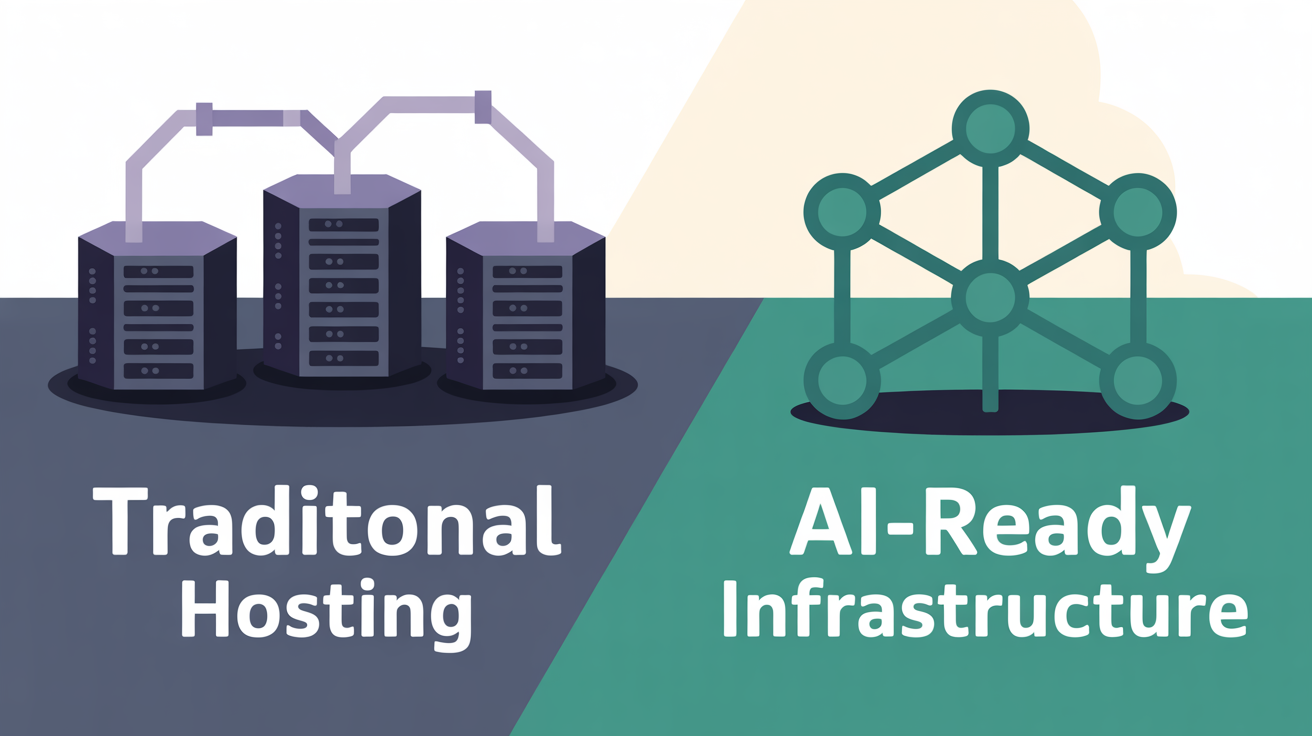
The Death of Client-Side WordPress: Server-Side AI Processing Takes Over
Here's the reality most business owners haven't connected yet: AI-driven automation has reduced downtime incidents by up to 40% compared to traditional reactive monitoring. But only when the AI can actually access your server.
Client-side AI tools hit a wall fast. Limited processing power. Battery drain. Network latency. Security restrictions. You're asking a phone to analyse a database with 50,000 products or diagnose a plugin conflict across 23 active extensions.
Server-side processing flips this completely. Your hosting infrastructure becomes the AI's workspace. Unlimited processing power. Direct database access. Real-time file modification. No network delays between the AI and your content.
The shift is already visible in developer workflows. Average WordPress developer rates run €70-105 per hour. AI tools with SSH access can diagnose issues in minutes that took developers two days manually. The labour cost savings are immediate.
But this creates a new bottleneck: your hosting infrastructure. Traditional shared hosting was built for serving HTML pages, not running AI workloads. The computational overhead of MCP protocol implementation requires resources most hosting platforms simply don't provision.
Why Current Managed Hosting Infrastructure Can't Handle MCP Workloads
Let me be direct about what's broken WP Engine's SSH Gateway creates sandboxed containers with 10-minute timeouts and 5 connection limits. Files disappear when sessions end. Tools vanish after timeout. This architecture makes AI agent automation impossible. Your AI assistant gets halfway through a task, hits the timeout, and loses all progress.
Bluehost requires a €26/month VPS upgrade just to enable SSH access. Their shared hosting plans can't support AI agents at all.
SiteGround offers SSH access from €3.50/month, but their starter plans lack sufficient resources for AI workloads. One heavy analysis task and your site crawls.
Even Kinsta, which provides full SSH access and AI-ready infrastructure, charges €31/month minimum. That's manageable for larger operations, but prohibitive for a café owner in Galway trying to automate their WordPress maintenance.
The fundamental issue: these platforms retrofitted AI capabilities onto infrastructure designed for different workloads. Managed WordPress hosting traditionally handled database queries and page caching. Now it needs to support real-time AI processing, parallel task execution, and sustained computational loads.
One thing current infrastructure cannot do: handle multiple AI agents working simultaneously. If your content team runs an SEO analysis while your developer deploys an update while your marketing automation processes customer data, something breaks. The server architecture wasn't designed for concurrent AI workloads.
The Irish Business Reality: Early Adopters vs Late Movers
Irish businesses face a compressed timeline that international companies don't, and what WordPress 7's AI revolution means for Irish SMEs specifically underscores the urgency. Ireland's National AI Office launches 2 August 2026. EU AI Act compliance isn't optional, it's regulatory requirement with €35 million penalties for serious violations.
Who Needs This Most?
-
eCommerce businesses: Your product catalogue, customer data, and transaction processing will require AI Act compliance documentation. MCP protocol lets AI agents audit your WordPress setup automatically instead of paying consultants €200/hour to do it manually.
-
Lead generation businesses: AI agents can monitor your contact forms, analyse conversion patterns, and identify technical issues before they cost you leads. One broken form during peak season could lose a €8,000 contract.
-
Service businesses and agencies: Client reporting, performance monitoring, and compliance documentation become automated workflows instead of manual monthly tasks.
I've seen the pattern in previous technology shifts. Early adopters gain 12-18 months of competitive advantage. Late movers spend double the money to catch up and still lag behind on expertise.
The businesses already preparing AI-powered server infrastructure that handles WordPress optimisation automatically will have AI agents managing their websites while competitors are still figuring out why their hosting provider can't support MCP protocol.
Web60's AI-First Architecture: Built for the MCP Era
Web60's infrastructure was designed with this shift in mind. SSH access included. WP-CLI support standard. Server resources provisioned for AI workloads, not just HTML delivery.
The difference shows in practical terms. Web60's managed WordPress stack runs on WordOps with Nginx, PHP-FPM, and Redis object caching. But more importantly, it provides the computational headroom for AI agents to work without throttling your live site performance.
Other hosting providers are reacting to WordPress 7.0's requirements. Web60 anticipated them. The AI-powered site builder already demonstrates server-side AI processing, customers describe their business and get a fully designed WordPress site in 60 seconds. That's MCP protocol capabilities in production today.
The practical advantage: when WordPress 7.0 launches 9 April 2026, Web60 customers won't need hosting migrations, infrastructure upgrades, or compatibility fixes. Their sites will support MCP protocol immediately.
The Dead Simple MCP Workflow
Step 1: Connect. AI agents access your Web60-hosted site via SSH and WP-CLI. No sandbox limitations, no session timeouts.
Step 2: Analyse. AI processes your content, database, and configuration files directly on the server. Full access, unlimited processing time.
Step 3: Execute. AI agents make changes, run optimisations, and generate reports without leaving the server environment. Everything happens where your website actually lives.
For Irish businesses preparing for August compliance deadlines, this isn't future technology, it's available now at €60/year with Irish-based infrastructure and support.
There is one scenario where traditional hosting might still work: if you're running a simple brochure site with no AI integration requirements and no EU compliance obligations. But that describes fewer businesses each month.
Conclusion
WordPress 7.0's MCP protocol isn't an upgrade, it's a fundamental shift that makes current hosting infrastructure obsolete. Server-side AI processing requires hosting platforms built for computational workloads, not just content delivery. Irish businesses face compressed timelines with EU AI Act compliance deadlines, making early adoption essential rather than optional. Web60's AI-first architecture provides the infrastructure foundation that traditional hosting cannot match, with SSH access, server resources, and Irish-based support ready for the MCP era. Don't wait until April to discover your hosting provider can't support WordPress 7.0's requirements. Explore Web60's AI-first hosting today.
Sources

Graeme Conkie founded SmartHost in 2020 and has spent years building hosting infrastructure for Irish businesses. He created Web60 after seeing the same problem repeatedly — Irish SMEs paying too much for hosting that underdelivers. He writes about WordPress infrastructure, server security, developer workflows, managed hosting strategy, and the real cost of hosting decisions for Irish business owners.
More by Graeme Conkie →Ready to get your business online?
Describe your business. AI builds your website in 60 seconds.
Build My Website Free →More from the blog
56% Customer Churn Rate Exposed: How Hosting Industry Consolidation Forces Irish Providers to Choose Between Price Wars or Premium Services
56% customer churn exposes hosting industry crisis. How consolidation forces Irish providers into price wars vs premium services - and what it means for your business.
The Brand Voice Control Myth: How WordPress 7.0 Just Made Editorial Workflow Tools Obsolete
WordPress 7.0's native Content Guidelines eliminate expensive editorial workflow subscriptions. Get brand voice control without third-party tools or oversight.